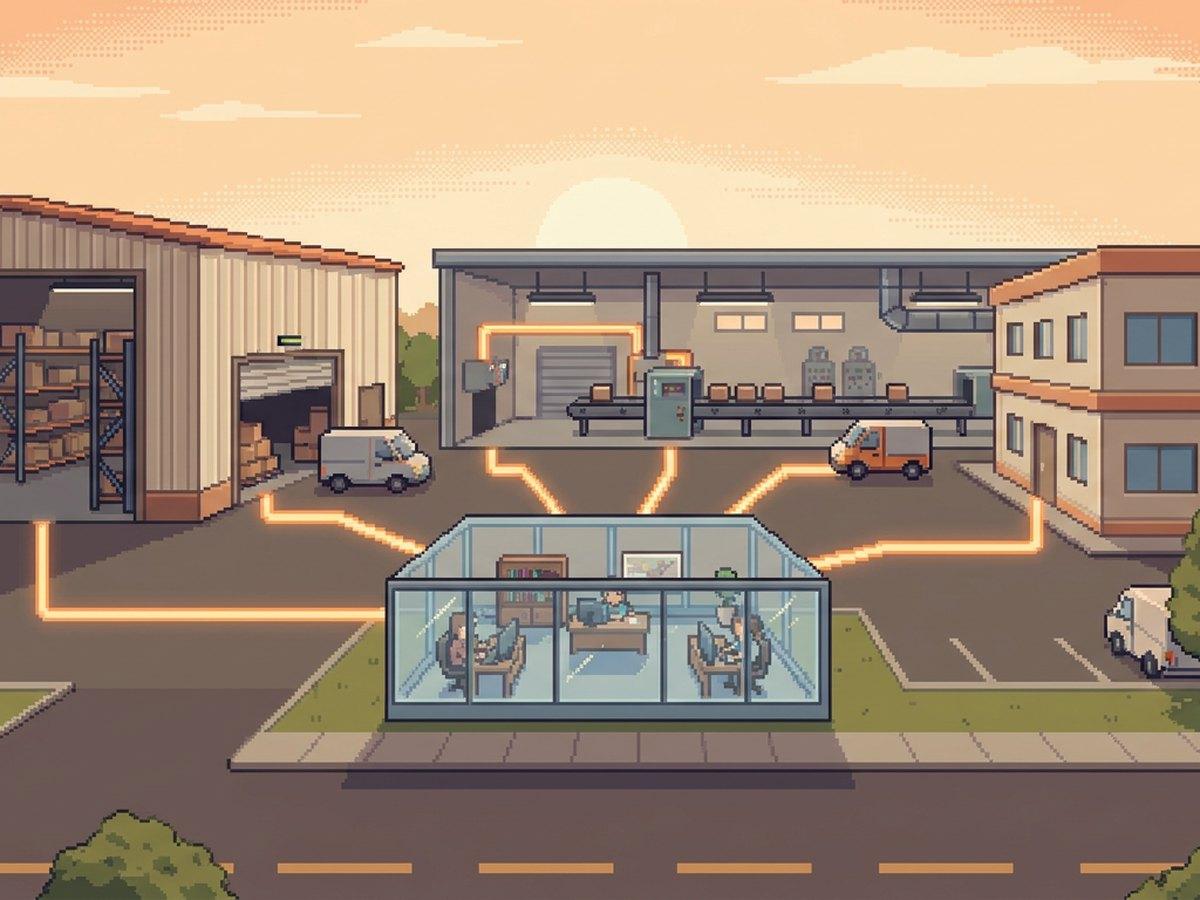
Most ERP vendors have added an AI button somewhere in the last two years. It sits in a corner of the screen. It summarizes a page or drafts an email. Then it goes quiet, because it does not actually know what is inside the ledger.
We built 1800 ERP the other way round. The assistant lives inside the system of record. It reads the same tables your accountants read, respects the same permissions, and writes back through the same workflows.
This post is about what changes when you do that, and why we built it on an open-source foundation.
The difference between beside and inside
An assistant that sits beside your ERP works from screenshots and exports. It can describe. It cannot act. Every answer is a copy of the truth, and copies drift.
An assistant that lives inside the ERP works from the live data. When it drafts a purchase invoice, the draft appears in the Buying module as a real document, waiting for approval. When it answers "Overdue AR by customer group?", it queries the receivables ledger as it stands right now, not the version someone exported last Tuesday.
That is the whole idea behind 1800 ERP. Finance, sales, inventory, manufacturing and HR run on ERPNext and the Frappe Framework, with AI working quietly in the background. Thirteen integrated modules, one database, one set of permissions. The assistant is a citizen of that system, not a visitor.
Four things the assistant does
- Document AI. Supplier PDFs become draft purchase invoices, with a two-way match against the purchase order before anyone approves.
- Reconciliation. Assistants reconcile records across the ledger, so closing the month is a review rather than an excavation.
- Forecasting. Demand forecasts are built from the sales and inventory history already in the system, and feed back into buying.
- Plain-language questions. Ask "Overdue AR by customer group?" in chat and get an answer drawn from live data.
None of these is exotic on its own. What matters is where they run. Because they run inside the system of record, the answer, the draft and the forecast all come from the same data your team already trusts. There is no export step, no second copy, no reconciliation of the reconciliation.
Why open source matters here
An assistant with read access to your entire ledger is a powerful thing. You should own it.
1800 ERP is built on ERPNext and the Frappe Framework, both open source. That has practical consequences. There are no per-user license traps, so adding a warehouse team or a second company does not trigger a bill. There is no vendor lock-in. You own the code and the data, and you can take both with you.
It also changes how customization works. Bespoke Frappe apps behave like native features. Same UI, same permissions, same database. When we extend the ERP for a client, the extension is not a fragile integration on the side. It is part of the system, so the assistant can see it too.
The result is a lower total cost of ownership, and, more importantly, a system you actually control.
Delivered end to end, anywhere
Software is only half of an ERP project. The other half is getting a real business onto it without losing a decimal.
1800 ERP is a product and an implementation practice. A typical launch runs about six weeks: discovery and blueprint in weeks one and two, configure and migrate in weeks three to five, train and go live in week six. Migration from Tally, spreadsheets or legacy systems comes with balances reconciled to the last cent. After go-live there is 24/7 SLA-backed support, with backups and upgrades handled for you.
We work remote-first and deliver worldwide. Tax templates are configured per country, whether that means VAT, GST or sales tax. Multi-company and multi-country setups are handled on the Enterprise tier. Pricing is published: Launch from $9.5K one time, Growth from $24K fixed scope, Enterprise custom. No per-user license fees at any level.
Where this is going
Onesage Inc. builds intelligent applications that run your business. 1800 ERP is the system of record. OneSage, our data intelligence platform at onesage.ai, sits above it and connects to more than a hundred other business systems. BrokerFlow does the same job for insurance brokers.
The thread through all three is the same. A small team should be able to run a large, complex operation. The software should carry the routine work and surface the decisions. AI that is bolted on cannot do that. AI that lives inside the system of record can.
If you are retiring spreadsheets or an aging desktop system, take a look at 1800erp.com.
Salman Mulani Founder, Onesage Inc.